 Alchemix
 v3 routes vault assets through MYT strategy adapters
Alchemix v3 uses MYT strategy adapters to connect a yield vault with individual DeFi strategies. The vault holds deposits and issues Mix-Yield Tokens, while adapters implement routes into and out of underlying protocols. Their supported actions, access controls and liquidity constraints determine how those assets move.
Updated ·Vault instructions and strategy execution
Vault-controlled adapter calls let pooled deposits reach external yield sources through strategy-specific code. Each adapter connects to a particular MYT vault, with that vault address fixed at deployment.
Portfolio allocation follows Alchemix DAO decisions, with execution currently handled by the DAO Multisig. An administrator or operator manages capital through
AlchemistAllocator
. The associated MYT vault alone can call an adapter’s
allocate
and
deallocate
entry points. A depositor holding MYT owns a share of the pooled assets; holding shares does not grant authority to route the vault’s capital.
For a specific strategy, the adapter implements entry, exit and reward handling around the underlying protocol. That division lets one MYT hold several strategies while exposing a single share token. The owner can also call
withdrawToVault
to return idle base assets left in an adapter to its MYT vault. This function sweeps existing idle assets, leaving capital still deployed in a strategy subject to that strategy’s exit logic.
MYT shares and adapter parameters
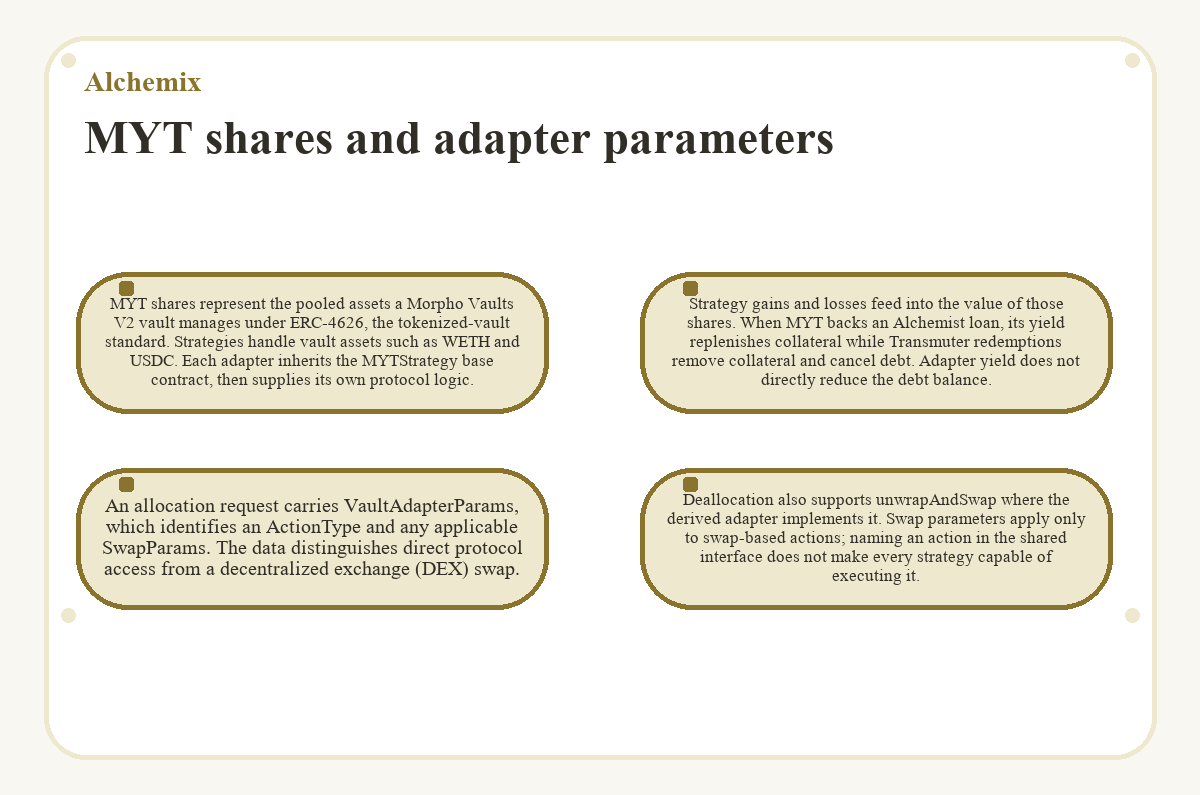
MYT shares represent the pooled assets a
Morpho Vaults V2
vault manages under ERC-4626, the tokenized-vault standard. Strategies handle vault assets such as WETH and USDC. Each adapter inherits the
MYTStrategy
base contract, then supplies its own protocol logic. Strategy gains and losses feed into the value of those shares. When MYT backs an Alchemist loan, its yield replenishes collateral while Transmuter redemptions remove collateral and cancel debt. Adapter yield does not directly reduce the debt balance.
An allocation request carries
VaultAdapterParams
, which identifies an
ActionType
and any applicable
SwapParams
. The data distinguishes direct protocol access from a decentralized exchange (DEX) swap. Deallocation also supports
unwrapAndSwap
where the derived adapter implements it. Swap parameters apply only to swap-based actions; naming an action in the shared interface does not make every strategy capable of executing it.
An allocation call from request to report
The
allocate
entry point turns an encoded route into a strategy operation and reports the change in deployed assets.
| Stage | Adapter operation | Controls and accounting |
|---|---|---|
| Request decoding | Read the action and applicable swap data | The associated MYT vault must call with a nonzero asset amount |
| Strategy execution | Run the implemented direct or swap entry | Allocation must be unpaused; unsupported actions revert |
| Allocation reporting | Return the adapter identifier and signed allocation change | The change equals the new allocation minus the previous allocation |
The allocation report associates a change in deployed capital with a particular adapter. Strategy execution determines the assets held afterward, including their yield exposure and exit conditions. A supported entry route alone does not establish an equally liquid exit.
Direct access and swap-based routes
Direct access uses the underlying protocol’s own wrap or unwrap path, while swap-based access converts assets through a DEX. The appropriate route follows the derived adapter’s supported implementation.
Protocol-native entry and exit
A
direct
action enters or exits without a DEX trade. That removes an exchange conversion from the route, although the underlying protocol can still impose withdrawal conditions. Direct access alone does not establish the strategy’s full risk classification.
Exchange conversion
Entry swaps
A
swap
allocation passes encoded calldata to the strategy’s swap route. The adapter converts the vault asset into the asset its strategy needs. The shared base contract provides entry points, while the derived adapter defines the executable conversion.
Unwrap-and-swap exits
The
unwrapAndSwap
action applies only to deallocation. It first unwraps the protocol token into an intermediate asset, then swaps that asset into the vault asset. Its
minIntermediateOut
parameter sets the minimum intermediate amount the unwrap must deliver before the swap. This floor concerns the intermediate token and its units.
Audit coverage and allocation risk
Strategy risk classifications connect adapter mechanics with the vault’s exposure limits. Every strategy added to an MYT requires independent audit coverage for its adapter code. Audit coverage does not remove loss or liquidity risk from the underlying strategy.
Conservative strategies combine direct contract entry and exit, fundamental-oracle pricing and no meaningful withdrawal delay. A DEX-dependent entry or exit, an externally priced oracle or a withdrawal lock can place a strategy in the Moderate category. Aggressive strategies add another risk factor to those conditions. Other classification inputs can raise a strategy’s category.
Classification also governs individual and aggregate allocation caps. The DAO checks those caps when allocating capital. Later withdrawals can shrink the vault enough to leave an existing allocation above its cap until rebalancing. Aggregate tier caps include that tier and every riskier classification.
Does pausing an adapter withdraw strategy assets?
An adapter’s
killSwitch
stops new allocations and reward claims without automatically unstaking or withdrawing the strategy’s assets.
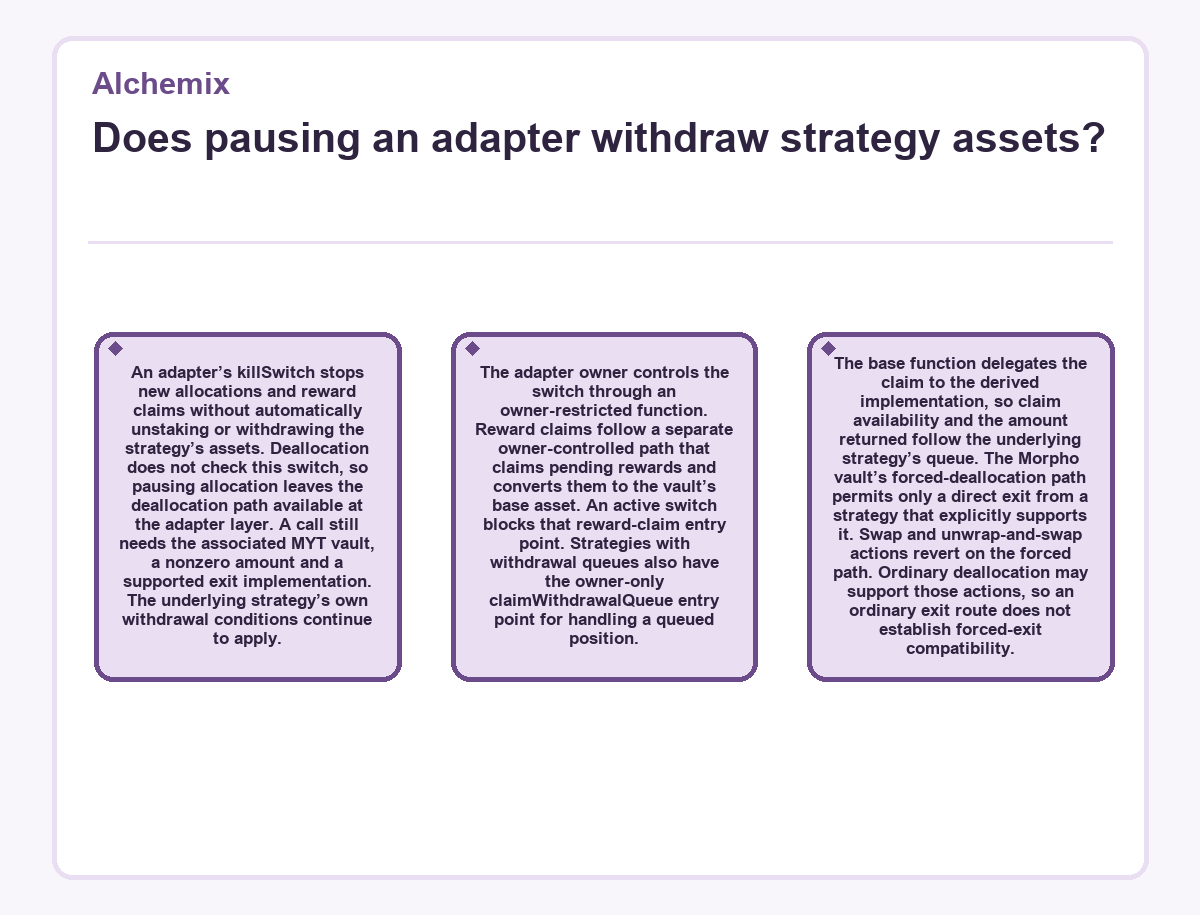
Deallocation does not check this switch, so pausing allocation leaves the deallocation path available at the adapter layer. A call still needs the associated MYT vault, a nonzero amount and a supported exit implementation. The underlying strategy’s own withdrawal conditions continue to apply.
The adapter owner controls the switch through an owner-restricted function. Reward claims follow a separate owner-controlled path that claims pending rewards and converts them to the vault’s base asset. An active switch blocks that reward-claim entry point. Strategies with withdrawal queues also have the owner-only
claimWithdrawalQueue
entry point for handling a queued position. The base function delegates the claim to the derived implementation, so claim availability and the amount returned follow the underlying strategy’s queue.
The Morpho vault’s forced-deallocation path permits only a direct exit from a strategy that explicitly supports it. Swap and unwrap-and-swap actions revert on the forced path. Ordinary deallocation may support those actions, so an ordinary exit route does not establish forced-exit compatibility.
Strategy liquidity and withdrawal value
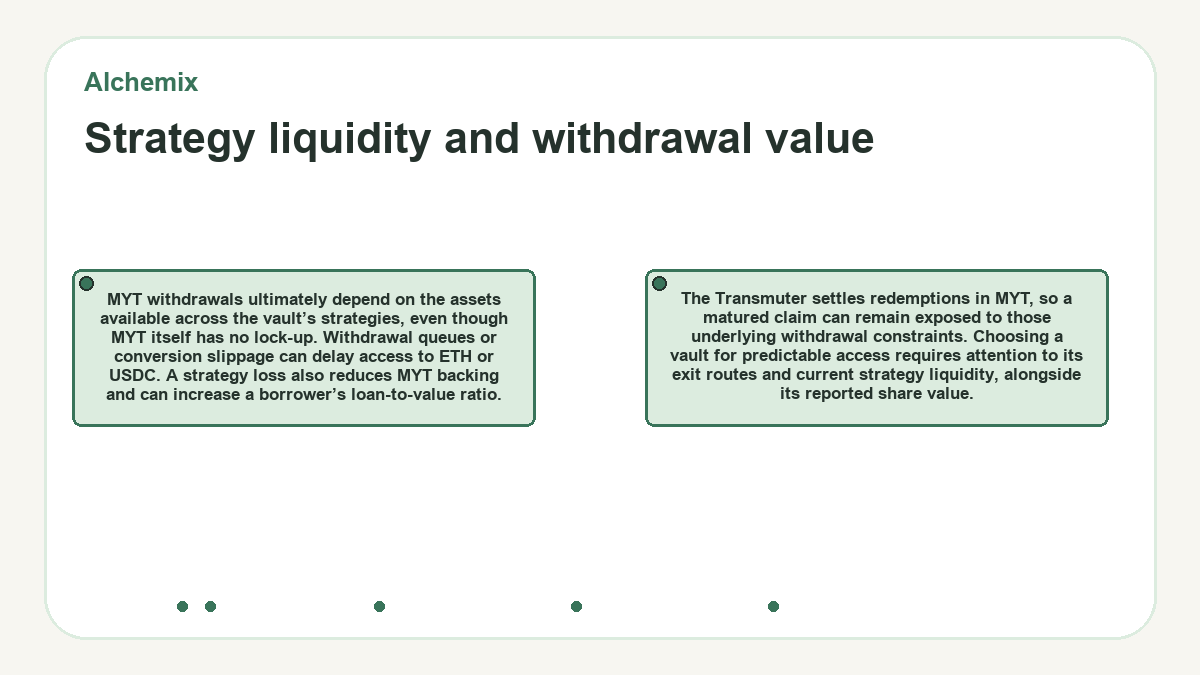
MYT withdrawals ultimately depend on the assets available across the vault’s strategies, even though MYT itself has no lock-up. Withdrawal queues or conversion slippage can delay access to ETH or USDC. A strategy loss also reduces MYT backing and can increase a borrower’s loan-to-value ratio. The Transmuter settles redemptions in MYT, so a matured claim can remain exposed to those underlying withdrawal constraints. Choosing a vault for predictable access requires attention to its exit routes and current strategy liquidity, alongside its reported share value.
Common questions about Alchemix
Which router handles the Stake DAO adapter’s swap route?
The Stake DAO strategy uses an Enso route for swap calldata. Most other MYT strategy swap routes use 0x AllowanceHolder calldata. This distinction belongs to the adapter’s implementation: the shared SwapParams structure carries the route data, while the selected strategy determines how to execute it.
How does the base swap helper restrict token spending?
The base dexSwap helper approves the 0x AllowanceHolder for the specified input amount, executes the supplied swap calldata and then revokes the approval. It checks the received amount against minAmountOut and reverts if the output falls short. These controls describe that helper’s execution path; they do not establish identical behavior for every derived adapter.
Why can an adapter’s recorded deployment owner differ from its current owner?
Transferring ownership changes the address controlling owner-restricted functions without updating params.owner. That parameter preserves the value recorded at deployment. Renouncing ownership instead sets the owner to the zero address and permanently disables those functions, including the kill switch, reward claims and token rescue.
Are the adapter’s cap fields enforced allocation limits?
The cap and globalCap fields are unused in the MYTStrategy base contract. MYT governance risk caps operate separately over portfolio composition and apply when the DAO allocates capital. An adapter’s stored cap fields therefore do not describe the vault’s enforced exposure limits.
Can an adapter owner recover tokens sent by mistake?
An adapter owner can recover mistakenly sent ERC-20 tokens only if the tokens are outside the adapter’s protected set. The rescueTokens function rejects a zero recipient address and an amount above the adapter’s token balance. The vault’s base asset is protected, and derived adapters can protect additional assets such as receipt or staking tokens.