 Alchemix
 Transmuter uses linear vesting to unlock MYT claims
Alchemix Transmuter in v3 uses linear vesting to convert alAsset deposits into claims on Mix-Yield Token (MYT) collateral. The normal redemption value is one unit of the underlying asset per vested alAsset. Depositors receive MYT, which the interface normally unwraps into ETH or USDC. The term follows the selected asset and chain. An early exit normally pays vested value in MYT and returns unvested alAssets minus their early-exit fee. Bad debt can reduce the MYT payout, and strategy liquidity can delay underlying withdrawals.
Updated ·Bottom line: MYT strategy liquidity can extend the time between a Transmuter claim and receipt of usable ETH or USDC.
Redeeming an alAsset bought below face value
A purchase below face value creates a potential spread between an alAsset’s acquisition cost and its v3 redemption entitlement. The holder commits the compatible token to a fixed-term claim. This use relies on the chosen market accepting deposits and the paired Alchemist retaining adequate backing. The spread compensates for waiting and exposure to that backing.
For alUSD, the claim targets USDC-denominated value; alETH targets ETH-denominated value. The market discount determines the gross spread, while the vesting duration determines its annualized rate. Trading costs, claim charges and the eventual MYT withdrawal affect what becomes usable proceeds. A fixed redemption ratio describes protocol accounting, with liquidity and bad-debt conditions governing realization.
Vesting, earmarking and the MYT payout
The v3 Transmuter connects a depositor’s vesting balance with debt in its paired Alchemist. Earmarking reserves borrower debt for later settlement from MYT collateral.
Vesting and reserved debt
Each v3 deposit vests linearly over its Transmutation Time. The protocol admin sets that duration per asset and chain under Alchemix DAO governance. The app shows the applicable term before a deposit. As vesting progresses, the protocol earmarks matching borrower debt. Collateral backing earmarked debt keeps earning while it remains in the borrowing position. Borrowers can settle that debt earlier with MYT or the underlying asset.
Settlement at the claim
Collateral transfer
Depositors initiate collection when the claim matures or later. The Transmuter first uses MYT it already holds, including prior repayments. It requests any remainder from the Alchemist, which draws borrower collateral and cancels the matching debt. If available MYT cannot cover the vested amount after any bad-debt adjustment, the claim returns that shortfall as alAssets without an early-exit fee. The Transmuter burns the settled alAssets and closes the position. Yield generated inside the remaining MYT replenishes borrower collateral; it does not directly cancel loan debt.
MYT share value
The claim measures underlying-asset value, so one vested alETH normally corresponds to one ETH worth of MYT. The number of MYT shares follows the vault’s exchange rate. Changing share value means an alAsset balance and a MYT share balance need not match numerically.
Which part of an early exit carries a fee?
The early transmutation fee applies only to unvested alAssets returned before maturity. Any MYT paid for the vested portion carries no early-exit fee.
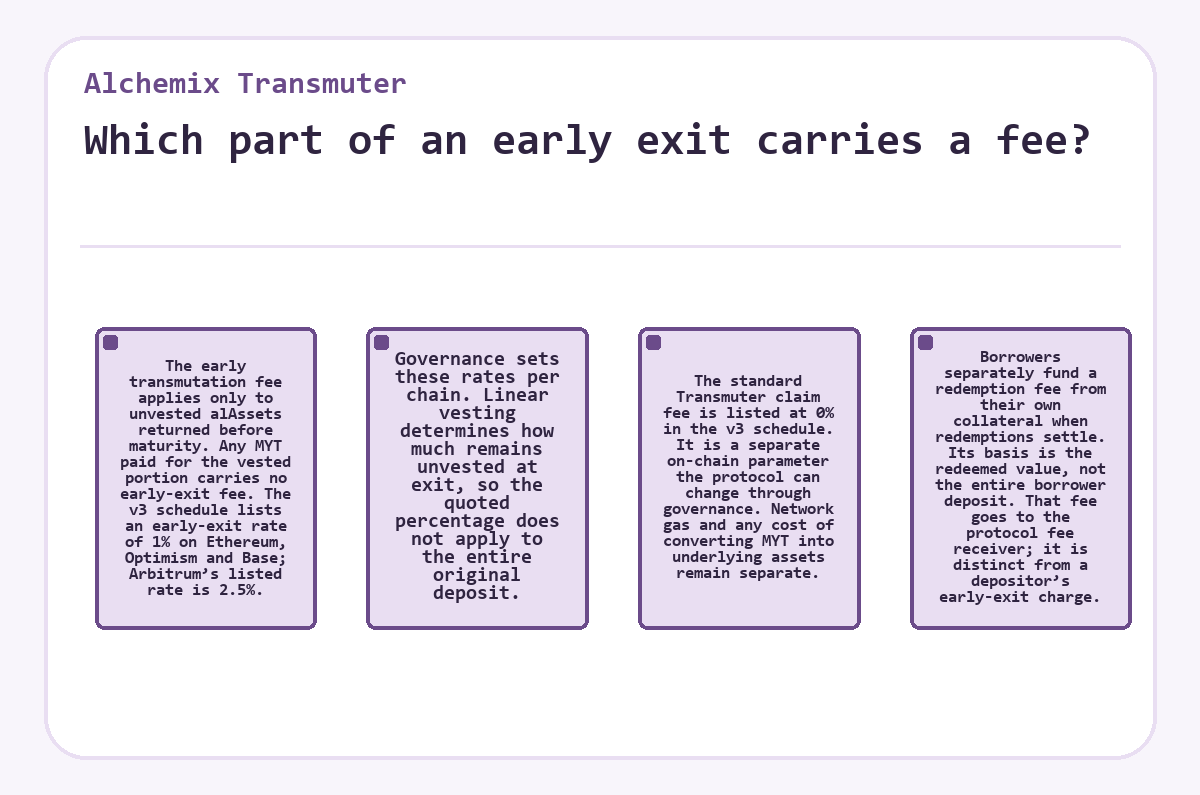
The v3 schedule lists an early-exit rate of 1% on Ethereum, Optimism and Base; Arbitrum’s listed rate is 2.5%. Governance sets these rates per chain. Linear vesting determines how much remains unvested at exit, so the quoted percentage does not apply to the entire original deposit.
The standard Transmuter claim fee is listed at 0% in the v3 schedule. It is a separate on-chain parameter the protocol can change through governance. Network gas and any cost of converting MYT into underlying assets remain separate.
Borrowers separately fund a redemption fee from their own collateral when redemptions settle. Its basis is the redeemed value, not the entire borrower deposit. That fee goes to the protocol fee receiver; it is distinct from a depositor’s early-exit charge.
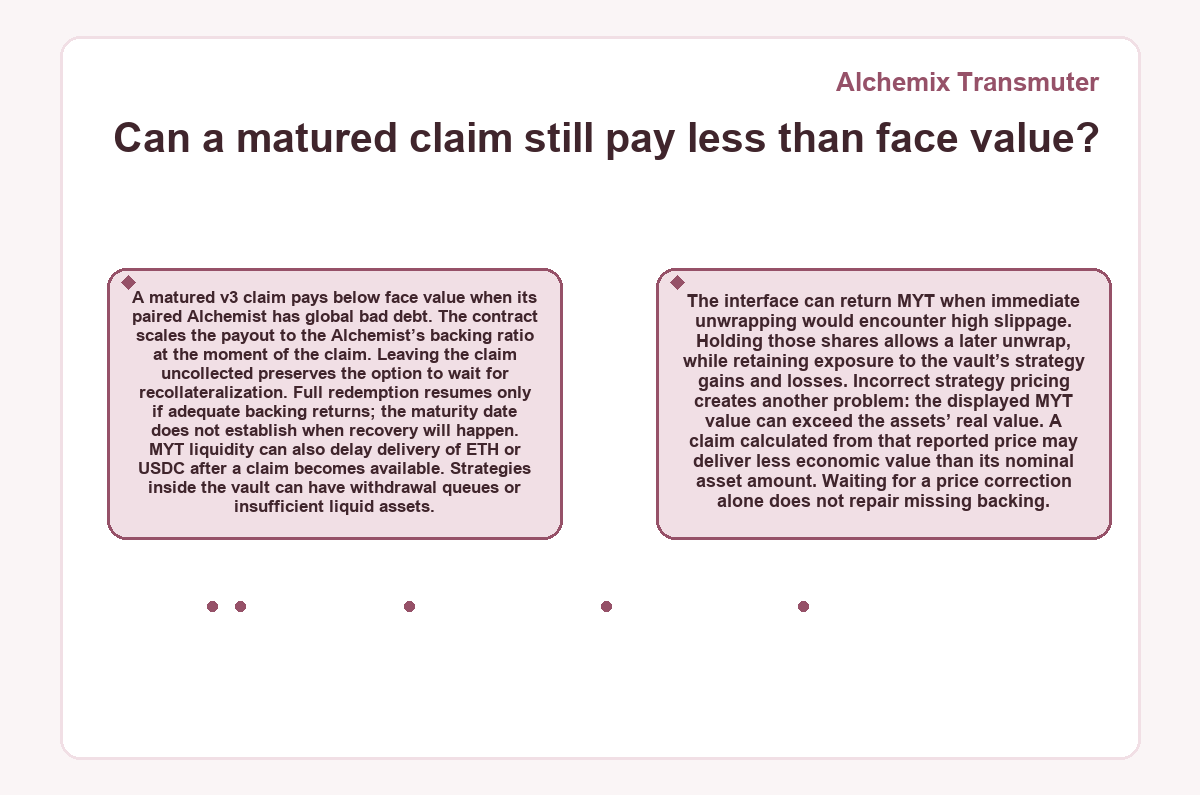
Can a matured claim still pay less than face value?
A matured v3 claim pays below face value when its paired Alchemist has global bad debt. The contract scales the payout to the Alchemist’s backing ratio at the moment of the claim. Leaving the claim uncollected preserves the option to wait for recollateralization. Full redemption resumes only if adequate backing returns; the maturity date does not establish when recovery will happen.
MYT liquidity can also delay delivery of ETH or USDC after a claim becomes available. Strategies inside the vault can have withdrawal queues or insufficient liquid assets. The interface can return MYT when immediate unwrapping would encounter high slippage. Holding those shares allows a later unwrap, while retaining exposure to the vault’s strategy gains and losses.
Incorrect strategy pricing creates another problem: the displayed MYT value can exceed the assets’ real value. A claim calculated from that reported price may deliver less economic value than its nominal asset amount. Waiting for a price correction alone does not repair missing backing.
Chain-specific markets and deposit limits
Each v3 Transmuter has a chain-specific deposit cap and an issuance constraint tied to its paired Alchemist. Spare space under one limit does not override the other.
| alAsset market | MYT backing and restrictions |
|---|---|
| Ethereum alETH | ETH-denominated MYT from the paired Ethereum Alchemist. |
| Ethereum alUSD | USDC-denominated MYT from the paired Ethereum Alchemist. |
| Optimism alETH | ETH-denominated MYT from the paired Optimism Alchemist. |
| Optimism alUSD | USDC-denominated MYT from the paired Optimism Alchemist. |
| Arbitrum alETH | ETH-denominated MYT; v3 wind-down approved. |
| Arbitrum alUSD | USDC-denominated MYT; v3 wind-down approved. |
| Base alUSDb | USDC-denominated MYT; accepts Base’s separate alUSDb token. |
| Shared limit | Deposits remain subject to local caps and the paired Alchemist’s issuance. |
Base’s alUSDb cannot bridge between chains. Bridged alUSD on Base is a different token and cannot enter the Base Transmuter. On the other listed chains, imported alAssets can exceed local burn capacity even when their ticker matches. Bridge transfers also depend on the relevant route’s available capacity.
AIP-124 passed on September 17, 2026. It approves the wind-down of v3 on Arbitrum and deprecation of alUSD and alETH bridging. The transition keeps those routes open pending implementation steps and timing, while new alUSD borrowing on Arbitrum is paused.
Immediate pool sales and timed redemptions
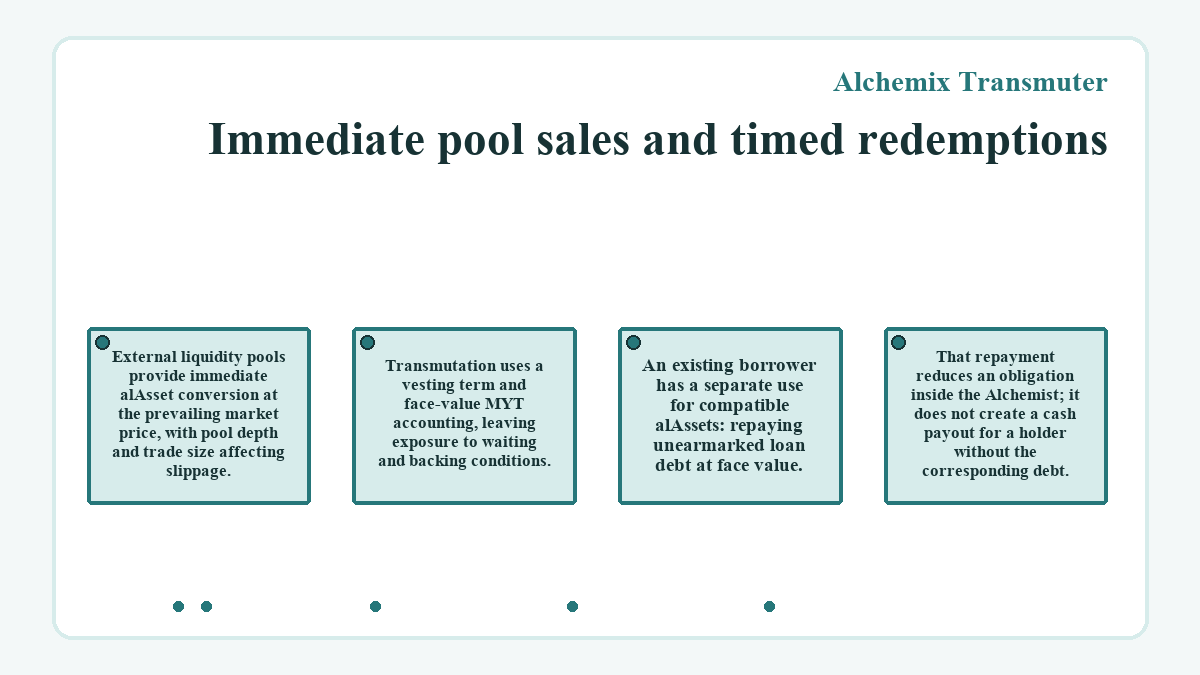
External liquidity pools provide immediate alAsset conversion at the prevailing market price, with pool depth and trade size affecting slippage. Transmutation uses a vesting term and face-value MYT accounting, leaving exposure to waiting and backing conditions. An existing borrower has a separate use for compatible alAssets: repaying unearmarked loan debt at face value. That repayment reduces an obligation inside the Alchemist; it does not create a cash payout for a holder without the corresponding debt.
Peg arbitrage, pool exits and treasury planning
Transmuter redemptions support peg arbitrage by giving discounted alAssets a timed route toward face value. Buying discounted supply and burning it through redemption helps pull the market price toward the protocol’s valuation. Liquidity providers can also exit a pool with alAssets and use transmutation to address the discount. Their total outcome still reflects the pool’s entry balance, liquidity fees earned and exit balance, alongside the eventual redemption value.
Timed claims can form part of treasury planning, provided both maturity and MYT withdrawal liquidity fit its funding horizon. A separate holding in the same MYT adds variable vault yield alongside the transmutation spread. Both holdings remain exposed to that MYT’s strategies.
Before committing alAssets, compare their acquisition cost with the claim value after charges. The apparent spread can disappear if an early exit becomes necessary or the Alchemist’s backing deteriorates.
Things people ask about Alchemix Transmuter
Can I deposit alAssets I bought without opening an Alchemix loan?
The Transmuter accepts compatible alAssets from holders who have no Alchemix borrowing position. Its deposit creates a redemption claim, while the paired Alchemist supplies the backing through borrower collateral. Buying alAssets on a market is one entry path, provided the token matches the selected chain’s Transmuter and the deposit fits its available capacity.
Which asset should I use to measure an alETH redemption discount?
Measure an alETH discount against ETH, because the v3 claim targets ETH-denominated MYT value, whereas changes in alETH’s dollar quote also reflect ETH’s dollar price and therefore do not isolate the discount relevant to transmutation.
Why can alAssets trade below face value despite the redemption mechanism?
Redemption requires time and usable capacity, so its face-value accounting does not force the market price to equal par. Borrower sales add alAsset supply to liquidity pools, while pool liquidity and sentiment influence the discount. Expected MYT withdrawal delays can also affect what buyers will pay for an eventual claim.
Does an ETH price decline liquidate a v3 Transmuter position?
An ETH price decline alone does not trigger a price-based liquidation of a v3 Transmuter position. The relevant exposure comes from MYT backing and the paired Alchemist’s collateralization, which can deteriorate through strategy losses or other failures. A lower dollar value for ETH and an actual loss of ETH-denominated backing describe different risks.
Is a quoted transmutation APR the return for one term?
The annual percentage rate (APR) annualizes the transmutation return; the term return measures the spread over the actual vesting period. A shorter term raises the annualized rate for the same gross term return. Acquisition costs and fees affect the net return, and a delayed MYT unwrap can extend the time before underlying assets become usable.