 Alchemix
 connects yield vaults with self-repaying loans
Alchemix combines yield vaults with self-repaying loans, using collateral redemptions to reduce a borrower’s debt. In v3, ETH or USDC deposits enter asset-specific Mix-Yield Tokens (MYTs). The Alchemist accepts MYT as collateral for borrowing, while the Transmuter handles timed redemptions of synthetic tokens called alAssets. Yield replenishes collateral as redemptions reduce debt. Holding MYT without a loan gives separate exposure to the strategies earning that yield.
Updated ·Borrowing against earning collateral
The Alchemist provides liquidity against MYT collateral, allowing the underlying deposit to keep earning while a borrowing position remains open. Where a market permits new borrowing, v3 supports up to 90% loan-to-value (LTV), calculated as debt divided by collateral value. The loan accrues 0% interest. ETH-backed borrowing mints alETH, while USDC-backed borrowing mints alUSD or, in Base’s separate market, alUSDb.
The initial deposit remains invested, and the newly minted alAsset supplies liquidity for use elsewhere. Debt and collateral share an underlying denomination. This relationship keeps a change in the base asset’s market price from triggering liquidation by itself, although losses within MYT can weaken the backing.
Mix-Yield Tokens
A Mix-Yield Token is a share in a Morpho Vaults V2 vault using the ERC-4626 tokenized-vault standard. Alchemix adds its own curator, allocator and strategy adapters around that vault. The adapters connect the vault to different yield sources, keeping MYT as a single claim on the pooled assets.
The DAO chooses strategies and their target weights. Its multisig executes allocations and rebalances the portfolio as conditions change. Yield increases the assets represented by each MYT share, while losses reduce its redemption value. Strategy holdings and weights can change, so the base asset alone does not describe a vault’s full exposure.
What makes a v3 loan self-repaying?
In v3, Transmuter redemptions automatically repay debt by drawing the matching value from borrower collateral. Yield does not directly cancel that debt; it adds value to the MYT collateral left in the position.
During vesting, the protocol earmarks borrower debt for eventual settlement. The associated MYT stays invested until the holder claims the redemption. Settlement removes collateral and cancels the corresponding debt. A borrower redemption fee applies separately. Borrowers can also repay part or all of their debt manually to release collateral.
A declining loan balance can therefore accompany a declining collateral balance. Whether yield replaces all the collateral drawn depends on the loan’s LTV, strategy returns and redemption activity. Lower leverage gives the yield more scope to offset those withdrawals.
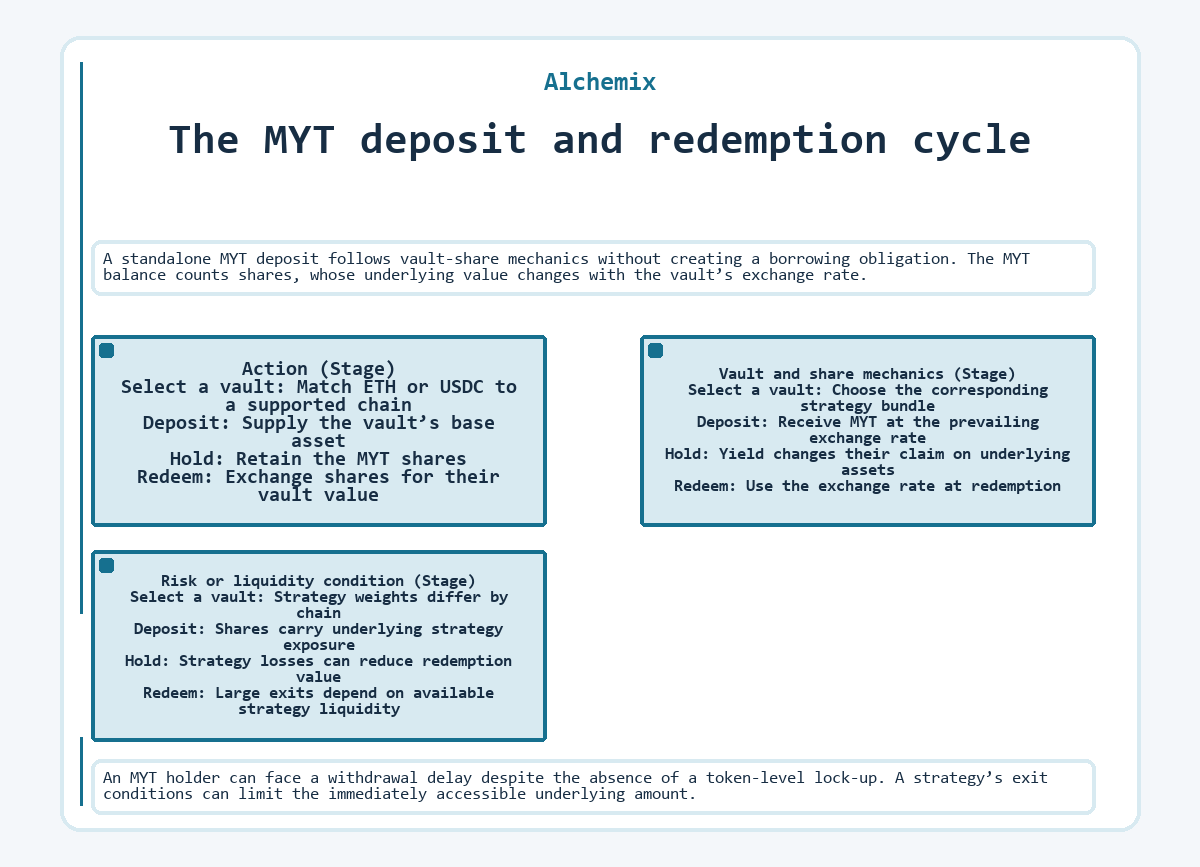
The MYT deposit and redemption cycle
A standalone MYT deposit follows vault-share mechanics without creating a borrowing obligation. The MYT balance counts shares, whose underlying value changes with the vault’s exchange rate.
| Stage | Action | Vault and share mechanics | Risk or liquidity condition |
|---|---|---|---|
| Select a vault | Match ETH or USDC to a supported chain | Choose the corresponding strategy bundle | Strategy weights differ by chain |
| Deposit | Supply the vault’s base asset | Receive MYT at the prevailing exchange rate | Shares carry underlying strategy exposure |
| Hold | Retain the MYT shares | Yield changes their claim on underlying assets | Strategy losses can reduce redemption value |
| Redeem | Exchange shares for their vault value | Use the exchange rate at redemption | Large exits depend on available strategy liquidity |
An MYT holder can face a withdrawal delay despite the absence of a token-level lock-up. A strategy’s exit conditions can limit the immediately accessible underlying amount.
Network-specific vaults and the Arbitrum wind-down
Ethereum, Optimism and Arbitrum have ETH-denominated and USDC-denominated MYTs, with strategies differing across chains. Ethereum uses the names mixETH and mixUSD. Base has a USDC-denominated vault the app calls Risk-adjusted Mix USDC, backing the separate alUSDb market.
AIP-124 passed on September 17, 2026, approving deprecation of alUSD and alETH bridging and the v3 Arbitrum wind-down. The announced interim arrangements keep bridge routes open pending further steps and timing, while new alUSD borrowing on Arbitrum is paused. A vault’s presence on a network does not establish that every borrowing action remains available there.
What does the Transmuter pay at maturity?
A holder can claim a matured v3 Transmuter position for MYT worth the redeemed underlying asset, subject to the Alchemist’s backing. The interface normally unwraps that MYT into ETH or USDC. Its 1:1 accounting measures underlying asset value, not the number of MYT tokens delivered. The protocol admin sets the waiting period per asset and chain under DAO governance.
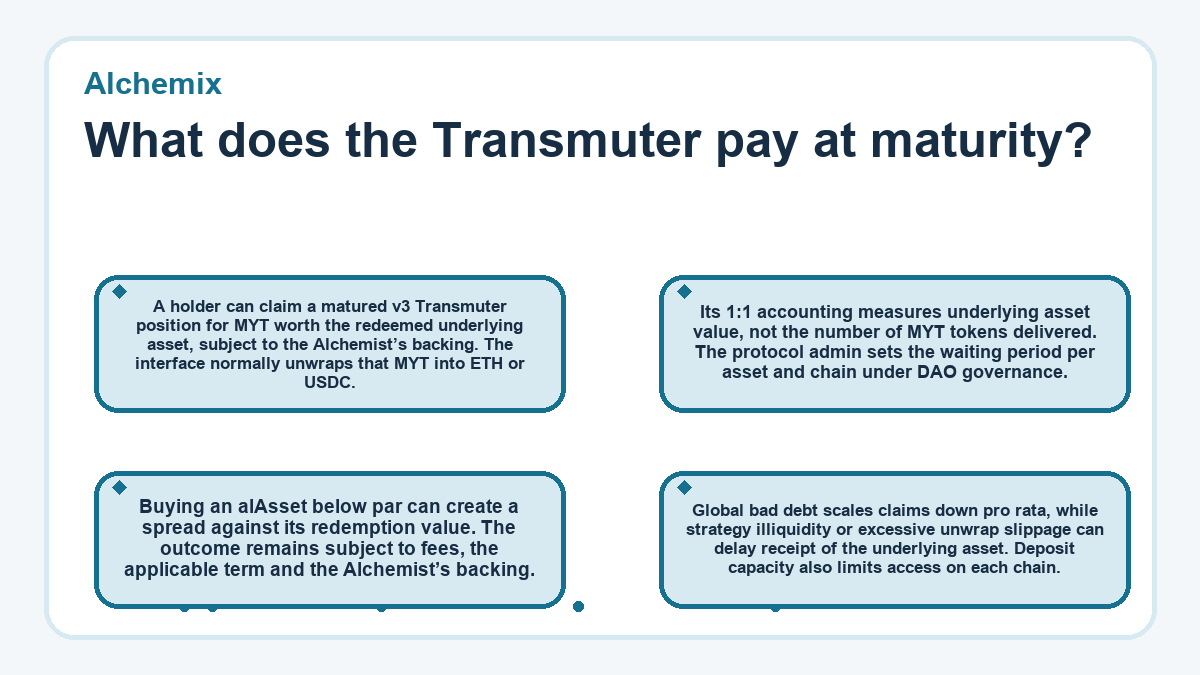
Buying an alAsset below par can create a spread against its redemption value. The outcome remains subject to fees, the applicable term and the Alchemist’s backing. Global bad debt scales claims down pro rata, while strategy illiquidity or excessive unwrap slippage can delay receipt of the underlying asset. Deposit capacity also limits access on each chain.
Strategy classifications and collateral risk
MYT strategies fall into Conservative, Moderate and Aggressive classifications based on how they enter, exit and value their positions.
Conservative strategies use direct contract entry and exit, fundamental pricing and no meaningful withdrawal delay. Moderate strategies may depend on a decentralized exchange, external pricing or a withdrawal lock. Aggressive strategies add another risk factor, such as a less proven strategy.
A strategy’s adapter code must have independent audit coverage before the strategy enters an MYT. Other factors, including strategy age, can raise a tier but cannot lower it.
Allocation rules limit individual strategies and combined higher-risk exposure. The DAO checks these caps when allocating funds. User withdrawals can push an existing weight above its cap until rebalancing.
Borrowers add collateralization risk to this underlying exposure. Losses inside MYT can raise LTV toward liquidation, and a higher starting LTV leaves less room for deterioration. Strategy classification and diversification change the exposure; they do not remove the possibility of a vault loss.
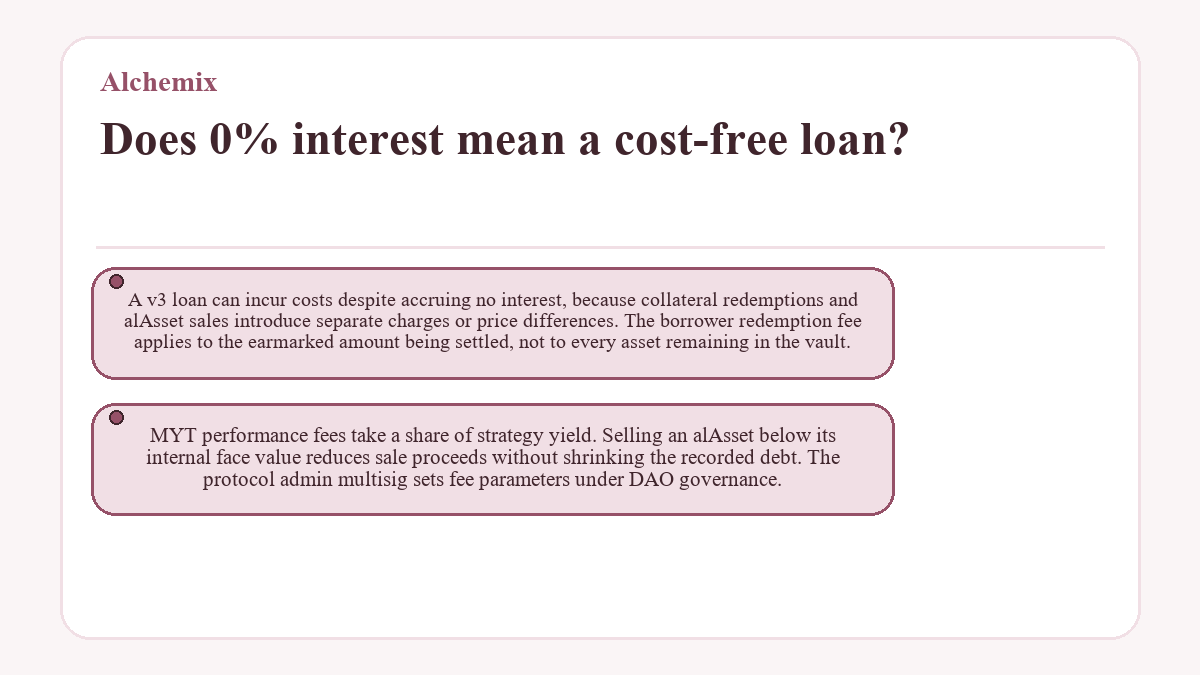
Does 0% interest mean a cost-free loan?
A v3 loan can incur costs despite accruing no interest, because collateral redemptions and alAsset sales introduce separate charges or price differences. The borrower redemption fee applies to the earmarked amount being settled, not to every asset remaining in the vault. MYT performance fees take a share of strategy yield. Selling an alAsset below its internal face value reduces sale proceeds without shrinking the recorded debt. The protocol admin multisig sets fee parameters under DAO governance.
Uses beyond the borrowing position
MYT holders can earn variable yield without opening a loan. The Alchemix Ecosystem Vault accepts WETH on Ethereum for exposure to liquidity pools, MYTs and fixed-yield Transmuter positions. Its performance fee comes from yield. alAssets also have uses beyond an immediate sale: dedicated Chronicle Labs price feeds let supported external lending markets value them as collateral. These uses retain the token’s own market and redemption characteristics. Putting a borrowed alAsset to work elsewhere leaves the debt in the original Alchemist position outstanding.
Questions and answers about Alchemix
Can bridged alUSD on Base repay an alUSDb loan?
Bridged alUSD on Base cannot repay alUSDb debt or enter the Base Transmuter. alUSDb belongs to Base’s separate market and is minted and burned only there. It cannot be bridged to another chain.
Which assets can settle debt already earmarked for redemption?
MYT or the corresponding underlying asset can settle earmarked debt in v3. alAssets can repay only debt that has not been earmarked. Settling the earmarked portion also incurs the borrower redemption fee, including when the borrower initiates repayment.
Is an early exit from the Transmuter possible?
An early Transmuter exit returns the vested portion as MYT and the unvested portion as alAssets, after an early-exit fee on the unvested amount. That fee does not apply to the vested share. The split follows linear vesting over the deposit’s applicable term, while the fee parameter differs by chain.
How are MYT performance fees calculated?
MYT performance fees take a vault-specific share of gross strategy yield before the remainder increases the MYT share value. The fee base is yield, not deposited principal. A vault earning no yield charges no performance fee. The protocol sets the rate separately for each vault.
Where can I see a particular MYT’s strategy allocations?
The Alchemix app’s Variable Rate area under Earn shows the live MYT composition, strategy weights and risk tiers. Those allocations belong to the selected chain and vault. Governance can change weights, so a previous composition or the shared MYT label does not establish the current portfolio.
How is a v3 borrowing position represented in a wallet?
A v3 borrowing position is represented by a non-fungible token (NFT) in the wallet after the transaction confirms. The NFT identifies the position; it is distinct from the MYT collateral and the borrowed alAssets.
Does reaching the borrowing cap automatically trigger liquidation?
Reaching v3’s 90% borrowing cap stops further borrowing; it does not by itself liquidate the position. The position stays open and keeps earning yield. Liquidation can follow a loss in MYT backing that pushes LTV past the separate liquidation threshold.