 Alchemix
 loans in v3 tie borrowing capacity and repayment to earning collateral
Alchemix loans let borrowers mint synthetic alAssets at up to 90% loan-to-value in v3 against yield-bearing Mix-Yield Token (MYT) collateral. Borrowing capacity changes with collateral value and outstanding debt. The debt accrues no interest, and Transmuter redemptions repay it by drawing collateral from the position. Yield replenishes that collateral; it does not directly cancel debt.
Updated ·The available loan also depends on the selected chain, its token and whether new borrowing remains open. Repayment choices change once debt becomes earmarked for redemption, while clearing debt and withdrawing spendable assets involve different constraints.
Bottom line: Clearing a v3 loan releases remaining collateral, while strategy liquidity determines when its MYT can become spendable ETH or USDC.
Collateral value and debt determine borrowing headroom
The 90% borrowing ceiling applies to a v3 position’s total debt, so existing debt reduces how much more it can mint. Loan-to-value (LTV) means debt divided by collateral value. MYT share pricing determines the value available to support that debt. A larger token balance does not necessarily mean greater capacity if the share price has fallen.
For collateral value C and outstanding debt D, the ceiling leaves borrowing headroom of 0.90 × C minus D, measured in the same underlying asset. A result at or below zero permits no additional minting. This relationship describes the LTV constraint; an open market and any active protocol restrictions also matter. The earmarked portion still counts as debt until settlement cancels it; reserving collateral does not create fresh borrowing capacity. Before committing, the borrower can choose a smaller mint or provide more collateral. Reaching the cap prevents further borrowing without automatically closing the position.
Lower LTV leaves more collateral buffer
Lower LTV leaves a larger cushion against a fall in MYT value and reduces the collateral redemptions consume relative to the whole deposit. Higher leverage provides more alAssets upfront while leaving less room for a strategy loss. That extra liquidity can earn elsewhere, with returns and risks separate from the collateral’s own performance. Yield may also fail to replace the collateral redemptions remove. A lower starting LTV can allow collateral to grow while debt declines, depending on yield and redemption activity. Neither outcome fixes the eventual repayment date or return.
Debt reductions and yield growth follow different paths
Automatic debt repayment in v3 follows Transmuter claims, while the remaining MYT collateral continues earning through its underlying strategies.
Debt settlement through redemptions
In a fully backed v3 Alchemist, Transmuter claims cancel borrower debt by removing matching MYT value from collateral. The borrower redemption fee adds a separate collateral charge. For an otherwise healthy position, the matched reduction lowers LTV without a payment from the borrower’s wallet.
Earmarking identifies debt committed to forthcoming redemptions. That collateral stays in the vault and earns until settlement. A Transmuter term does not give every borrower a matching payoff deadline: the amount of debt repaid depends on claims, queue depth and system debt.
Yield growth within collateral
MYT strategies add net yield to the collateral’s redemption value. If that growth exceeds the value removed through redemptions and fees, collateral can increase while debt falls. Lower yield or heavier redemption activity can produce a shrinking collateral balance even as the debt decreases.
A strategy’s yield rate cannot independently predict when a loan will finish repaying. Borrower equity, meaning collateral value minus debt, can change differently from either balance.
Borrowing capacity and sale proceeds measure different amounts
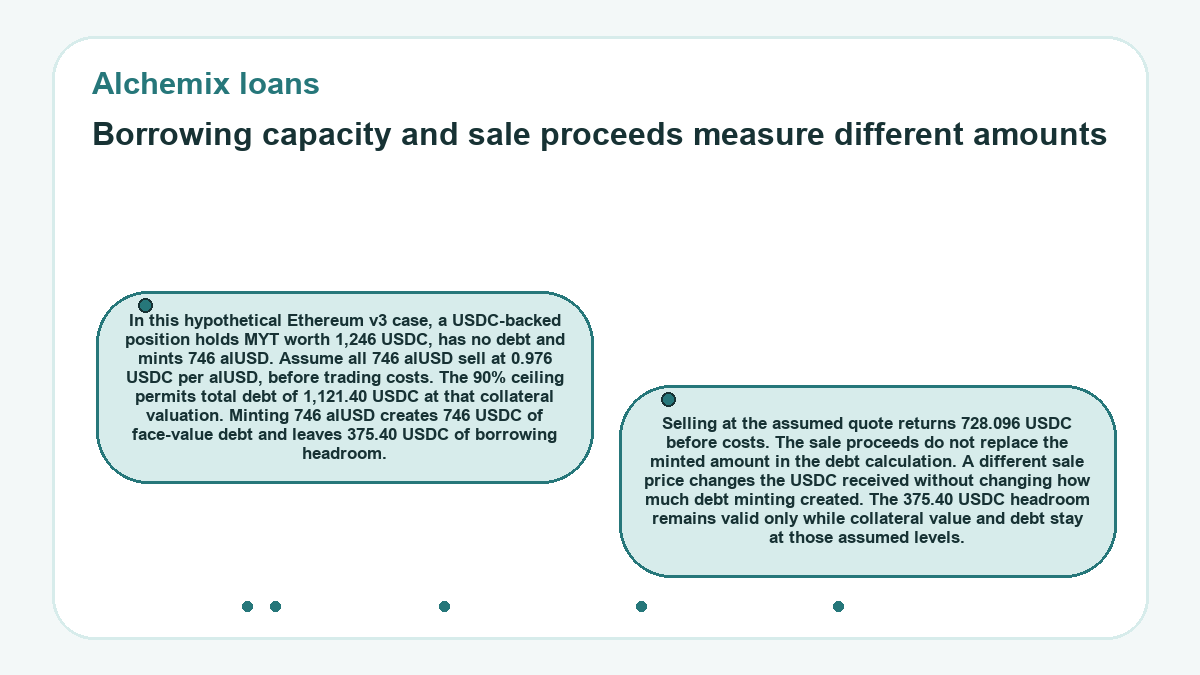
In this hypothetical Ethereum v3 case, a USDC-backed position holds MYT worth 1,246 USDC, has no debt and mints 746 alUSD. Assume all 746 alUSD sell at 0.976 USDC per alUSD, before trading costs.
The 90% ceiling permits total debt of 1,121.40 USDC at that collateral valuation. Minting 746 alUSD creates 746 USDC of face-value debt and leaves 375.40 USDC of borrowing headroom. Selling at the assumed quote returns 728.096 USDC before costs. The sale proceeds do not replace the minted amount in the debt calculation.
A different sale price changes the USDC received without changing how much debt minting created. The 375.40 USDC headroom remains valid only while collateral value and debt stay at those assumed levels.
Repayment assets depend on earmarked debt
Repayment asset selection depends on whether debt remains unearmarked or the protocol has reserved it for Transmuter redemptions. The distinction can split a single position’s balance.
Unearmarked debt
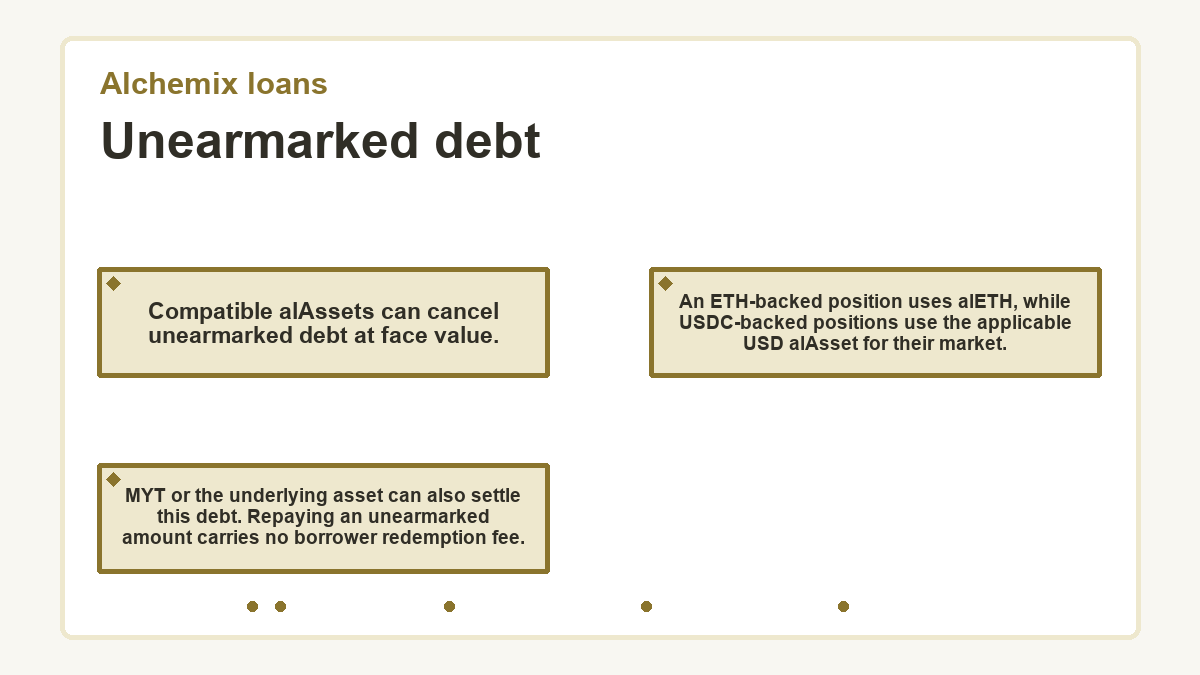
Compatible alAssets can cancel unearmarked debt at face value. An ETH-backed position uses alETH, while USDC-backed positions use the applicable USD alAsset for their market. MYT or the underlying asset can also settle this debt. Repaying an unearmarked amount carries no borrower redemption fee.
Earmarked debt
Earmarked debt requires MYT or the underlying asset, including when a borrower settles it voluntarily. An alAsset repayment cannot clear that reserved portion. Repayment with MYT or the underlying settles earmarked debt first, and the borrower redemption fee applies to the earmarked amount settled.
Zero interest leaves redemption and trading costs
A 0% interest rate leaves the debt free of interest accrual; redemption fees and the alAsset sale discount still affect what a borrower retains. The current v3 borrower redemption fee is 0.25% on Ethereum, Optimism and Arbitrum, versus 0.10% on Base. Governance sets it per chain. This fee applies to the earmarked amount settled, rather than the position’s entire collateral balance.
MYT performance fees reduce yield before it increases the collateral’s share value. They charge yield rather than principal, and the rate varies by vault. Quoted sale prices, trading charges and the redemption rate affect borrowing costs independently of the zero-interest label. An annual cost estimate also needs the proportion of debt actually redeemed during that year.
A confirmed loan has a position NFT and separate balances
After the borrowing transaction confirms, a position NFT represents the v3 loan in the wallet. The Alchemist lending contract records collateral and debt for that position, while minted alAssets are separate tokens available to the borrower. A market sale changes token holdings without reducing recorded debt. Later position checks need outstanding debt, collateral value and the earmarked balance; the amount originally minted no longer describes the whole obligation after redemptions or repayments.
Chain status and token identity restrict available actions
The selected chain determines the debt token and available borrowing market. Base’s v3 market uses USDC-backed alUSDb, which cannot be bridged to other chains. Bridged alUSD on Base cannot repay alUSDb debt.
AIP-124 passed on September 17, 2026, approving the deprecation of alUSD and alETH bridging and a v3 wind-down on Arbitrum. New alUSD borrowing on Arbitrum is paused. Existing bridge routes remain open pending the implementation steps and timing the team announces, subject to rate limits and capacity. The pause prevents new Arbitrum alUSD loans even when collateral would otherwise support the mint.
The Alchemist also rejects new deposits and loans when the face value of its outstanding alAssets exceeds their backing. That backing includes locked Alchemist collateral and MYT held by its paired Transmuter. This global bad-debt condition can block borrowing even if an individual position has unused LTV headroom. A Guardian pause can separately stop new deposits and loans following suspicious activity.
MYT losses change liquidation and repayment outcomes
The v3 liquidation threshold is 95% LTV, above the 90% borrowing cap. Like-kind debt and collateral move together when the underlying asset’s market price changes. Falling MYT share value can push a v3 position above the liquidation threshold. Strategy losses and market discounts on externally priced strategy tokens can reduce that value.
Earmarked repayment before liquidation
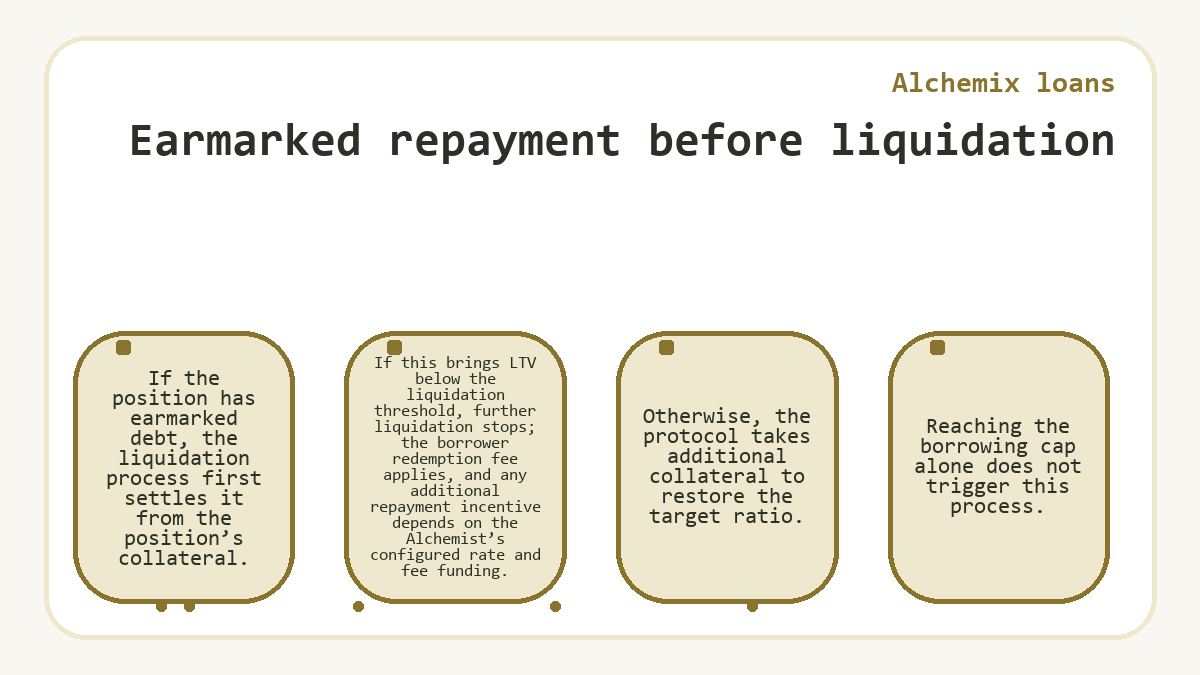
If the position has earmarked debt, the liquidation process first settles it from the position’s collateral. If this brings LTV below the liquidation threshold, further liquidation stops; the borrower redemption fee applies, and any additional repayment incentive depends on the Alchemist’s configured rate and fee funding. Otherwise, the protocol takes additional collateral to restore the target ratio. Reaching the borrowing cap alone does not trigger this process.
Partial and full liquidation
A partial liquidation charges the current 1.50% liquidator fee on surplus collateral, meaning collateral value above debt. The position normally funds that fee; a separate fee vault can pay fees the position cannot safely cover, up to the vault’s available balance. Full liquidation applies when position debt reaches or exceeds collateral value, or the position remains eligible for liquidation and its Alchemist is below its global minimum collateralization. In that case, the fee uses debt as its base and comes from the fee vault. Liquidation sends seized collateral to the Transmuter to support redemptions.
Debt repayment and underlying withdrawal have different constraints
Full manual repayment clears the borrowing obligation and unlocks the position’s remaining collateral. Partial repayment reduces debt and can make more collateral withdrawable within the LTV limit. Neither action restores collateral earlier redemptions or fees consumed.
Unlocked MYT remains a claim on the vault’s strategies. Its redemption value reflects their gains and losses, and obtaining underlying ETH or USDC depends on available liquidity. MYT itself has no lock-up, although some strategies have delayed exits. A borrower can therefore finish repaying before the remaining collateral becomes available as spendable underlying assets.
Questions people ask about Alchemix loans
Can someone else repay my Alchemix loan?
Any wallet can repay a v3 position, including a position held by another address. The repayment still follows the position’s earmarked-debt rules. MYT or the underlying asset can settle earmarked debt, and the borrower redemption fee applies to that portion even when someone else pays.
Why can an Alchemist reject otherwise compatible alAssets for repayment?
Each Alchemist limits alAsset repayments to its outstanding issuance on that chain minus alAssets locked in its paired Transmuter. A bridged balance can therefore exceed what the destination deployment can burn, even when the token otherwise matches the loan. This capacity is separate from the borrower’s debt balance and its earmarked portion.
Does Alchemix v3 allow minting and repayment on the same position in the same block?
The v3 Alchemist prevents minting and repayment on the same position in the same block. Reversing those operations within the block does not remove the restriction.
Which fees apply to a voluntary self-liquidation?
A v3 self-liquidation pays no liquidator fee. Settling earmarked debt still incurs the borrower redemption fee on that portion, using the applicable chain’s rate.
How can MYT withdrawals change a loan’s exposure to risk categories?
User withdrawals can raise an existing strategy’s percentage of a shrinking MYT above its allocation cap. The DAO checks caps when allocating capital and may need to rebalance after withdrawals. A loan’s exposure therefore follows the MYT’s actual composition, which can temporarily differ from the allocation limits.